
Transparify White Paper · Chapter 5
Case Studies
The following case studies demonstrate how the AMLR calculation logic applies to structures encountered in everyday practice, from direct shareholdings to multi-tier partnerships with circular cross-holdings. Each case sets out the ownership structure, applies the AMLR rules step by step, and states the outcome.
Case Study 1: Direct Shareholding
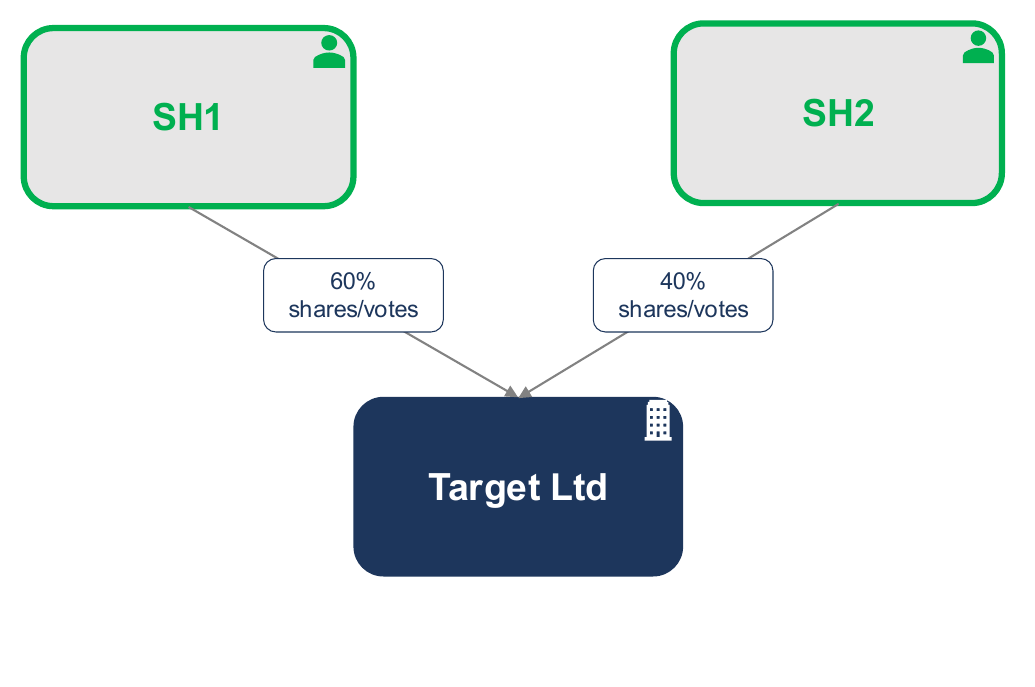
Assessment
- SH1 60% ≥ 25% → Beneficial Owner via Ownership Interest (AMLR Art. 52)
- SH1 60% > 50% → also Control through ownership interest (AMLR Art. 53(2))
- SH2 40% ≥ 25% → Beneficial Owner via Ownership Interest only
Result
- SH1 and SH2 are both Beneficial Owners
- SH1 qualifies on two grounds (Ownership Interest and Control); SH2 on Ownership Interest alone
Case Study 2: Multi-Level Holding Chain
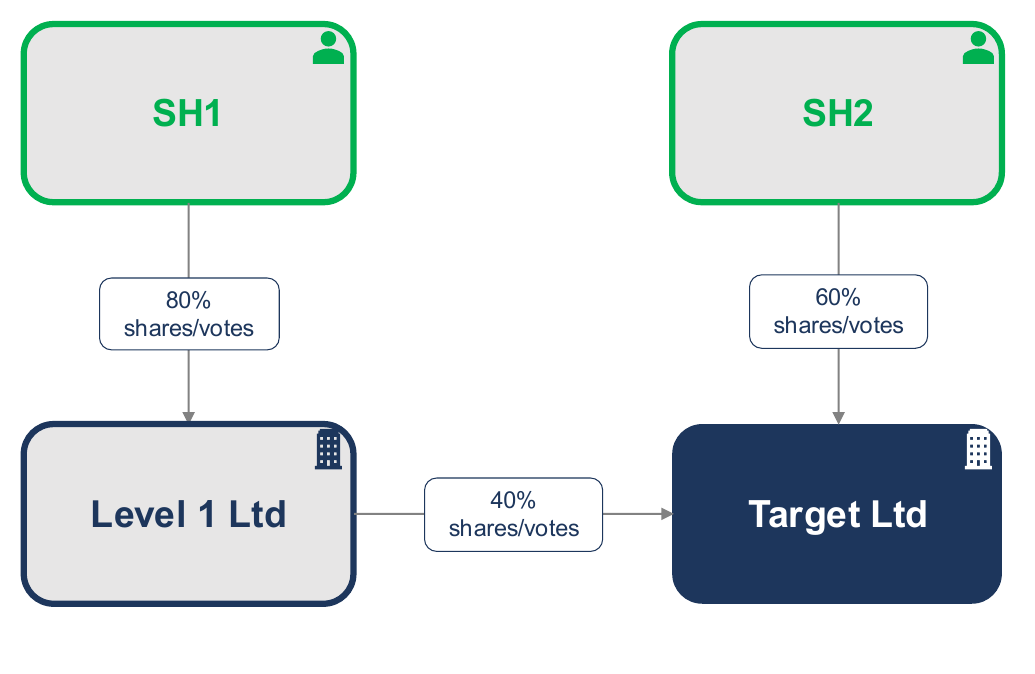
Assessment
- SH1: 80% × 40% = 32% indirect Ownership Interest ≥ 25% (AMLR Art. 52, accumulation approach)
- SH1 controls Level 1 Ltd (80% > 50%), but Level 1 Ltd holds only 40% of Target Ltd → the 50%+1 majority is not met at this level of the chain, so SH1 does not qualify for Control through Ownership Interest
- SH2: 60% direct Ownership Interest ≥ 25%, and 60% > 50% → SH2 qualifies for both Ownership Interest and Control through Ownership Interest
Result
- SH1 is a Beneficial Owner through Ownership Interest alone (32% indirect stake ≥ 25%)
- SH2 is a Beneficial Owner through both grounds: Ownership Interest (60% direct ≥ 25%) and Control through Ownership Interest (60% direct majority)
Case Study 3: Treasury Shares Adjustment
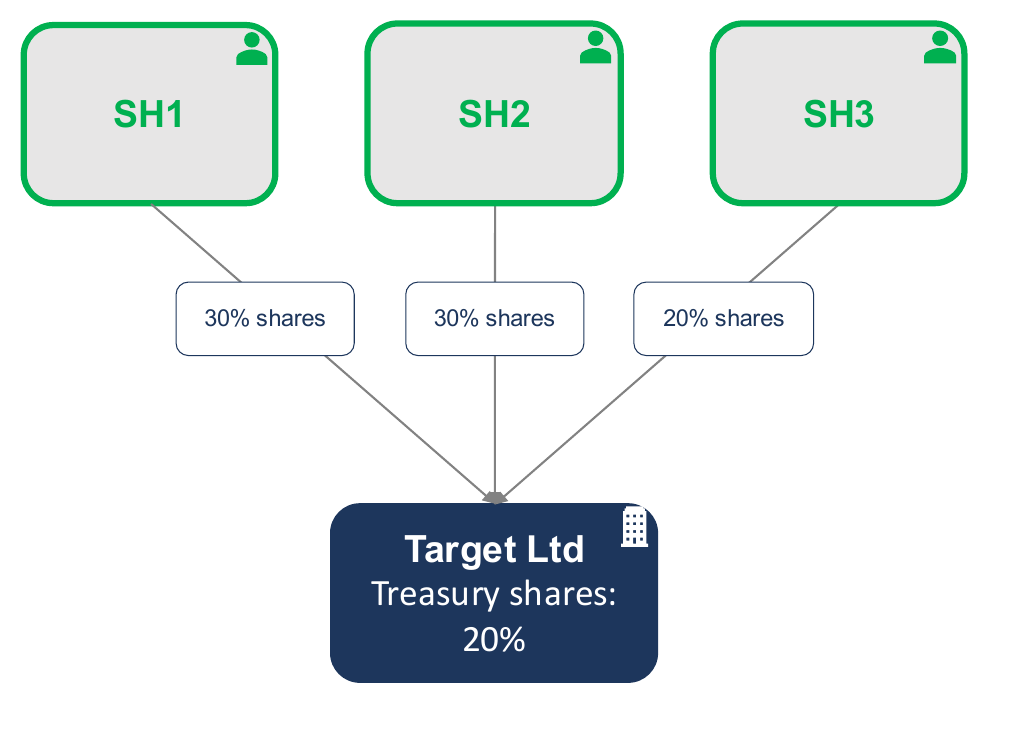
Assessment
- Treasury shares (20%) excluded from denominator → external basis = 80%
- SH1: 30 / 80 = 37.50% → Beneficial Owner
- SH2: 30 / 80 = 37.50% → Beneficial Owner
- SH3: 20 / 80 = 25.00% → Beneficial Owner (nominal percentage below UBO threshold, however, as treasury shares are excluded from the calculation basis, SH3 reaches 25% through adjustment)
Result
- SH1, SH2 and SH3 are Beneficial Owners.
Case Study 4: Intermediate Level Treasury Shares Adjustment
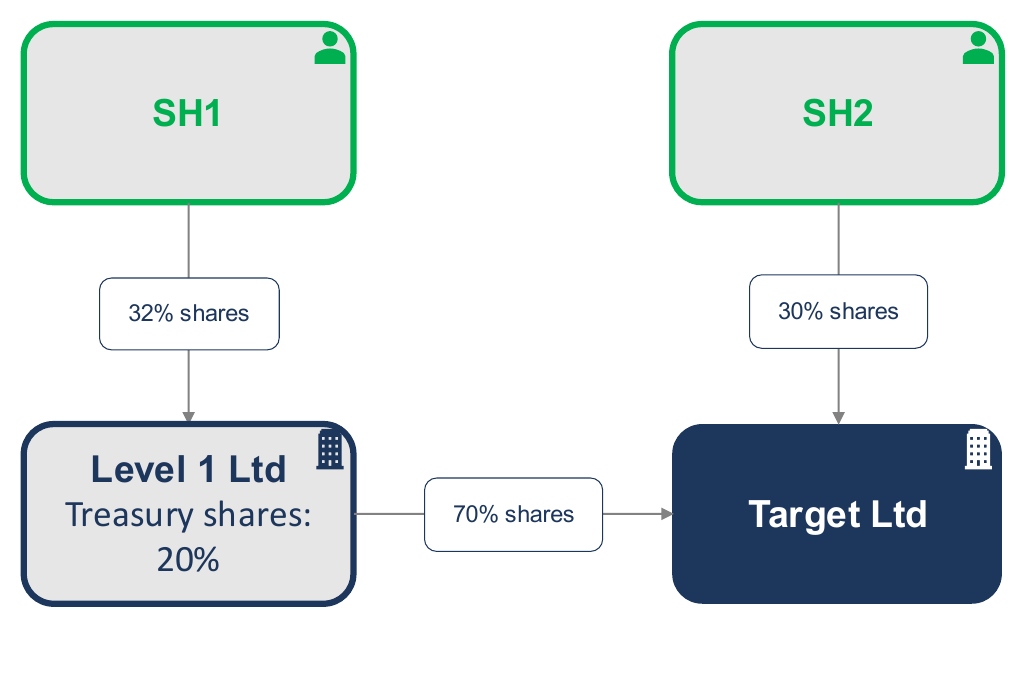
Assessment
- Level 1 Ltd treasury shares (20%) excluded → SH1 adjusted stake in Level 1 Ltd = 32/80 = 40%
- Correct indirect stake in Target = 40% × 70% = 28% ≥ 25% → Beneficial Owner
- Nominal calculation (no adjustment): 32% × 70% = 22.4%, which would incorrectly miss SH1
- SH2: 30% direct ≥ 25% → Beneficial Owner, no adjustment needed
Result
- SH1 is an indirect Beneficial Owner (28%) as own-shares adjustments also apply to intermediate entities, in this case Level 1 Ltd.
- SH2 is a direct Beneficial Owner (30%)
Case Study 5: Acting in Concert with Others
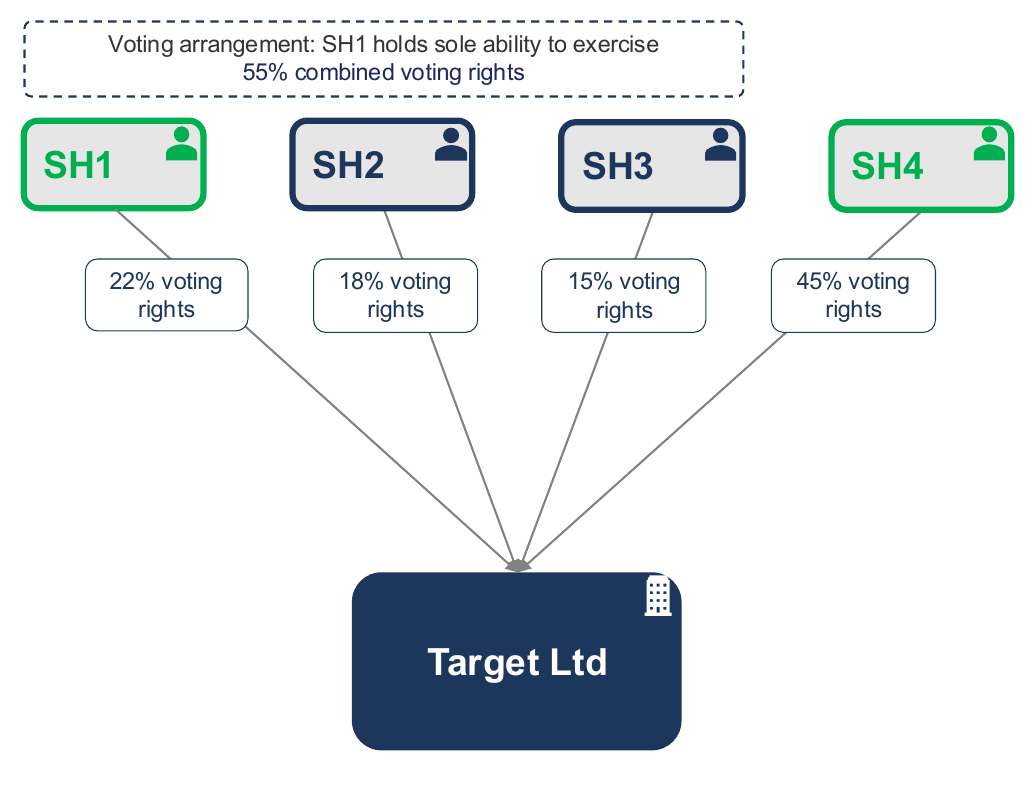
Assessment
- SH1, SH2, SH3 individually below 25%; combined stake = 55%, a majority of voting rights
- SH1 solely holds the ability to exercise the group‘s voting rights: the combined majority is attributed to SH1 as Control via other means (AMLR Art. 53(3)(a))
- SH4: 45% direct: Ownership Interest (AMLR Art. 52) only; 45% does not reach the 50%+1 majority needed for Control (AMLR Art. 53(2))
Result
- SH1 (acting in concert, combined majority, sole ability to exercise) and SH4 (direct 45%) are Beneficial Owners. SH2 and SH3 are members of the concerted group but hold no independent Beneficial Owner status; control is attributed solely to SH1 as the person directing the majority bloc.
Case Study 6: Relevant Veto/Decision Right
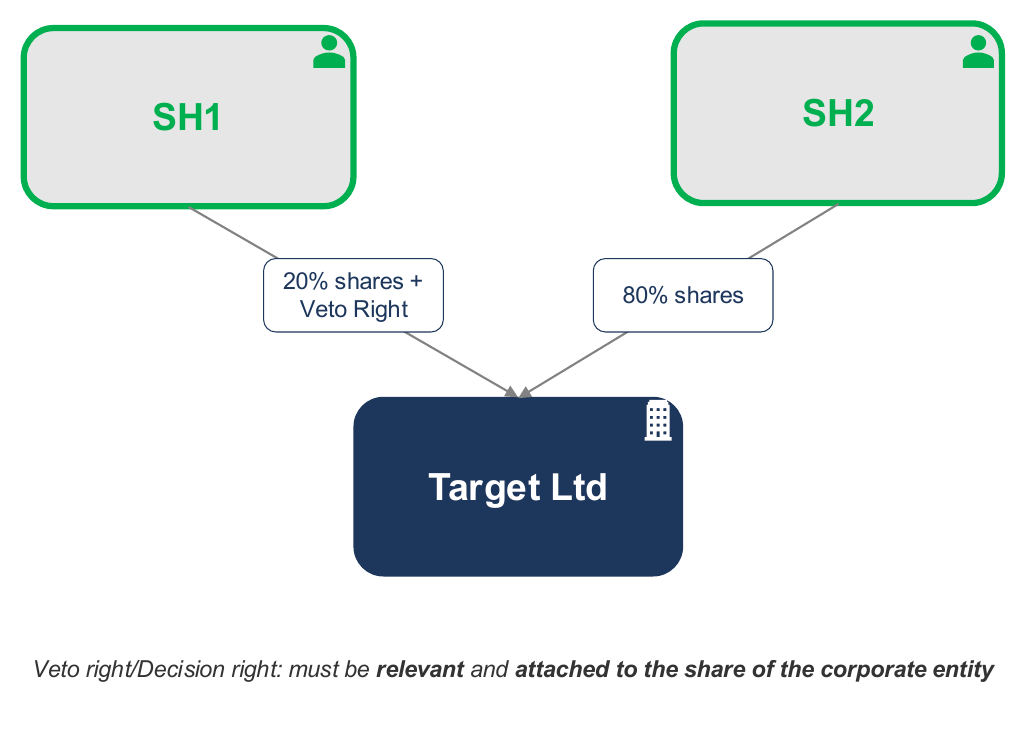
Veto right/Decision right: must be relevant and attached to the share of the corporate entity
Assessment
- SH1: 20%, below the 25% Ownership Interest threshold (AMLR Art. 52)
- SH1's veto right covers strategic decisions and is attached to SH1's shareholding → relevant veto right, Control via other means (AMLR Art. 53(3)(c))
- SH2: 80% ≥ 25% and > 50% → Ownership Interest (AMLR Art. 52) and Control through Ownership Interest (AMLR Art. 53(2))
Result
- SH1 qualifies as a Beneficial Owner via Control (veto right) despite holding only 20%.
- SH2 qualifies on both Ownership Interest and Control through Ownership
Case Study 7: Nominee Agreement
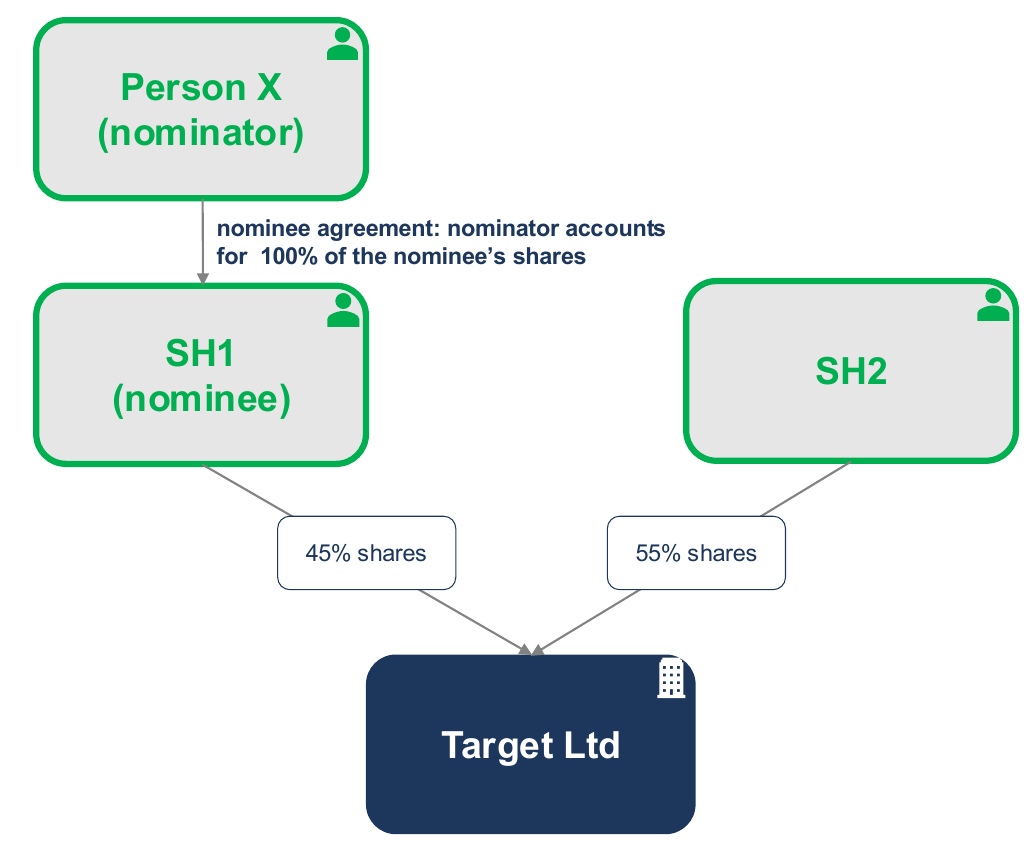
Nominee agreement: nominator accounts for 100% of the nominee’s shares
Assessment
- SH1 (nominee) holds 45% as registered shareholder → Beneficial Owner via Ownership Interest (AMLR Art. 52); documented as nominee
- Person X (nominator): X qualifies via Control through the nominee arrangement (AMLR Art. 53(4))
- SH2: 55% direct → Ownership Interest (AMLR Art. 52) and Control through Ownership Interest (AMLR Art. 53(2))
Result
- SH1 is a UBO via Ownership Interest as the registered holder
- Person X qualifies through control through the nominee arrangement as 100%*45% ≥ 25%.
- SH2 qualifies via direct Ownership Interest and Control through Ownership
Case Study 8: Cooperative with Equal Voting Rights
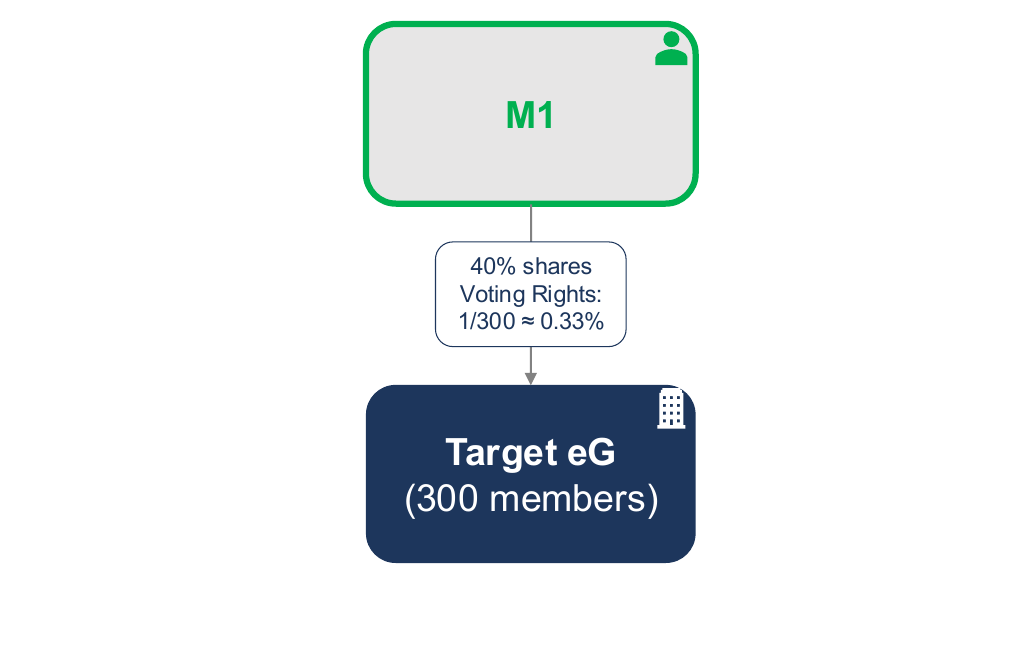
Assessment
- Shares and voting rights are independent Ownership Interest categories (AMLR Art. 52)
- M1: 40% shares ≥ 25% → Beneficial Owner via Ownership Interest
- M1: 1 vote of 300 ≈ 0.33%, far below both the 25% and 50%+1 thresholds → no ground for beneficial ownership
Result
- M1 is a Beneficial Owner via shares (40%) only, not via voting rights (0.33%) and not via Control.
Case Study 9: General Partner Held by Its Limited Partnership
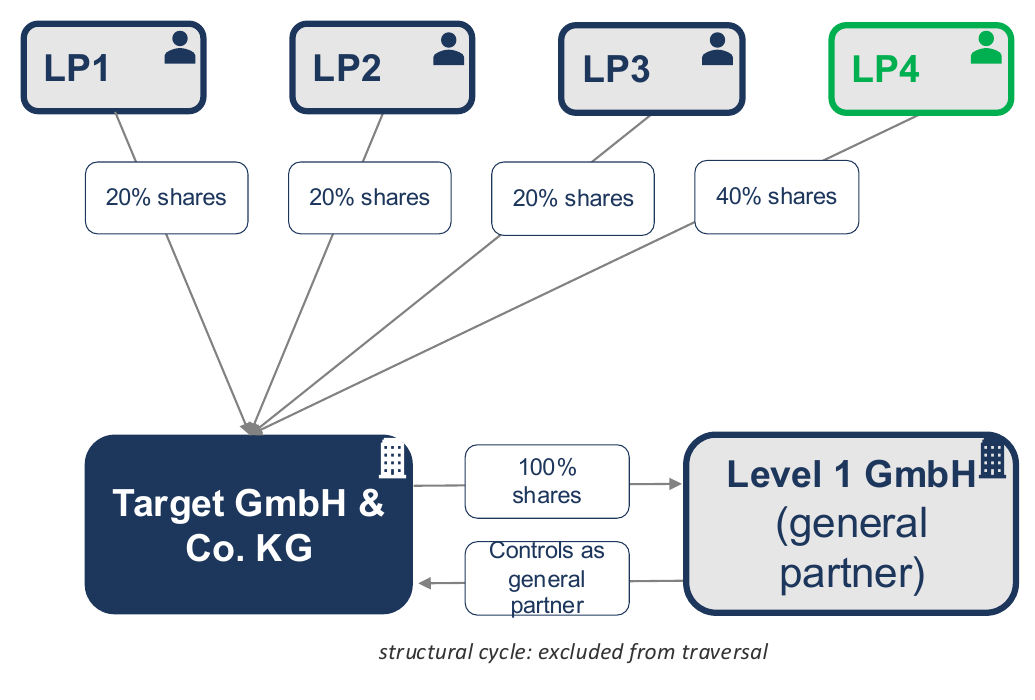
Structural cycle: excluded from traversal
Assessment
- GP function is Control via other means, independent of capital (AMLR Art. 53(3))
- Target GmbH & Co. KG owns 100% of Level 1 GmbH, which controls Target GmbH & Co. KG as general partner → structural cycle
- Transparify excludes circular links from the traversal once an already-visited entity is re-entered
- LP4 holds 40% of Target GmbH & Co. KG’s shares → Beneficial Owner under AMLR Art. 52
Result
- LP4 is the sole Beneficial Owner of Target GmbH & Co. KG. The cycle is detected and excluded; it does not create a second Beneficial Owner or leave the structure unresolved.
Case Study 10: Circular Cross-Holding and SMO Fallback
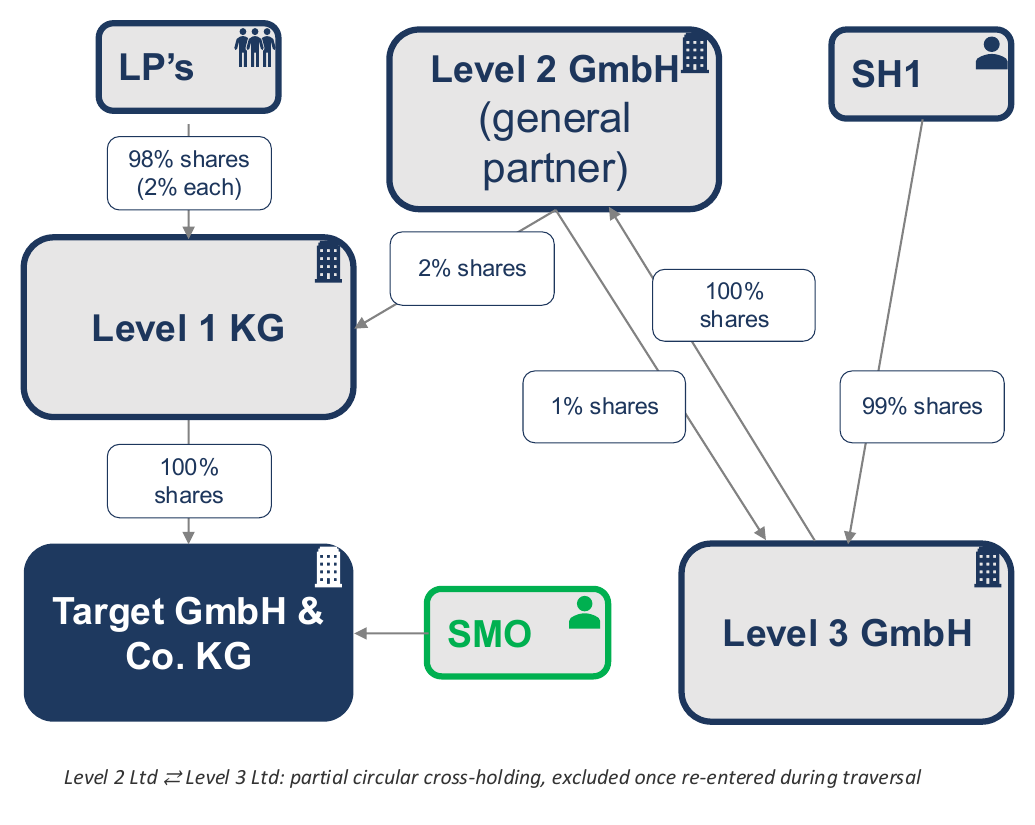
Level 2 Ltd ⇄ Level 3 Ltd: partial circular cross-holding, excluded once re-entered during traversal
Assessment
- None of the limited partners (2% each) reaches the 25% threshold
- Level 2 Ltd (general partner) and Level 3 Ltd hold partial reciprocal stakes in each other. This circular link is excluded, so that only the remaining ownership interest holders (in this case SH1) are looked at
- SH1 also does not reach the 25% threshold (99%100%2%=1,98%) and there are no control factors throughout the structure
Result
- No natural-person Beneficial Owner is identified. SMO Fallback applies to Target Ltd.
Case Study 11: Dispersed Ownership (SMO Fallback)
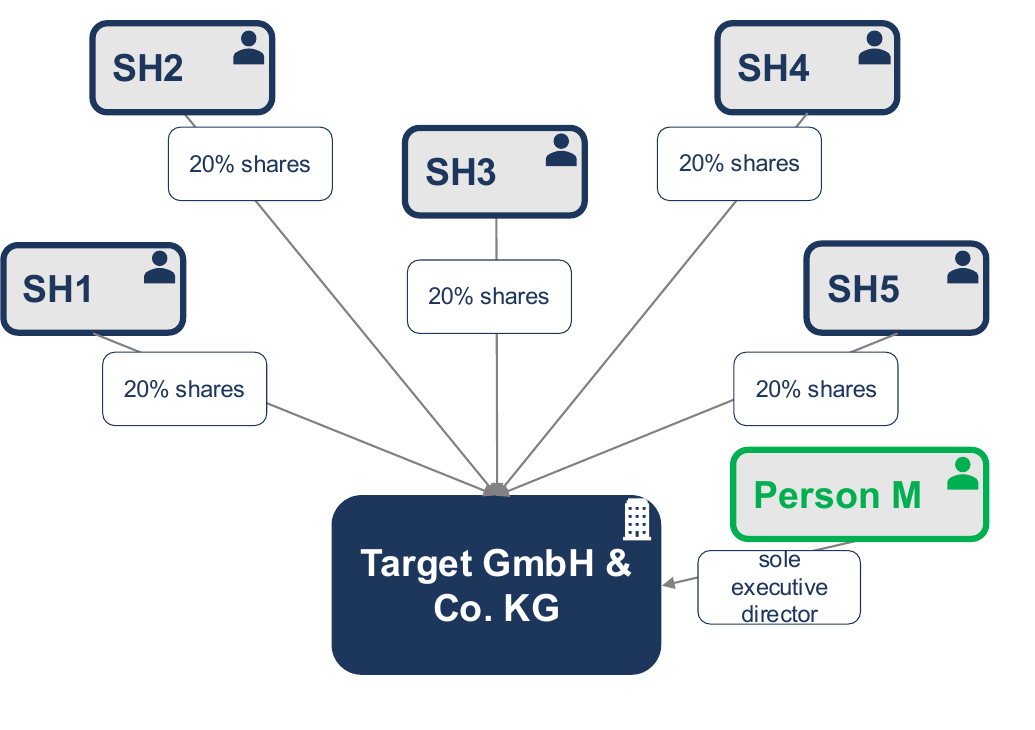
Assessment
- No shareholder reaches 25% → no Beneficial Owner via Ownership Interest (AMLR Art. 52)
- No control factors present (veto, appointment rights, agreements) → no Beneficial Owner via Control (AMLR Art. 53)
- SMO fallback applies (AMLR Art. 22(2))
- Person M, sole executive director → executive member of the management body → Senior Managing Official
Result
- No Beneficial Owner is identified. Person M is recorded as Senior Managing Official; the file must document all investigative steps and the reasons no Beneficial Owner could be found.
Case Study 12: Veto Right Exercised at an Intermediate Level
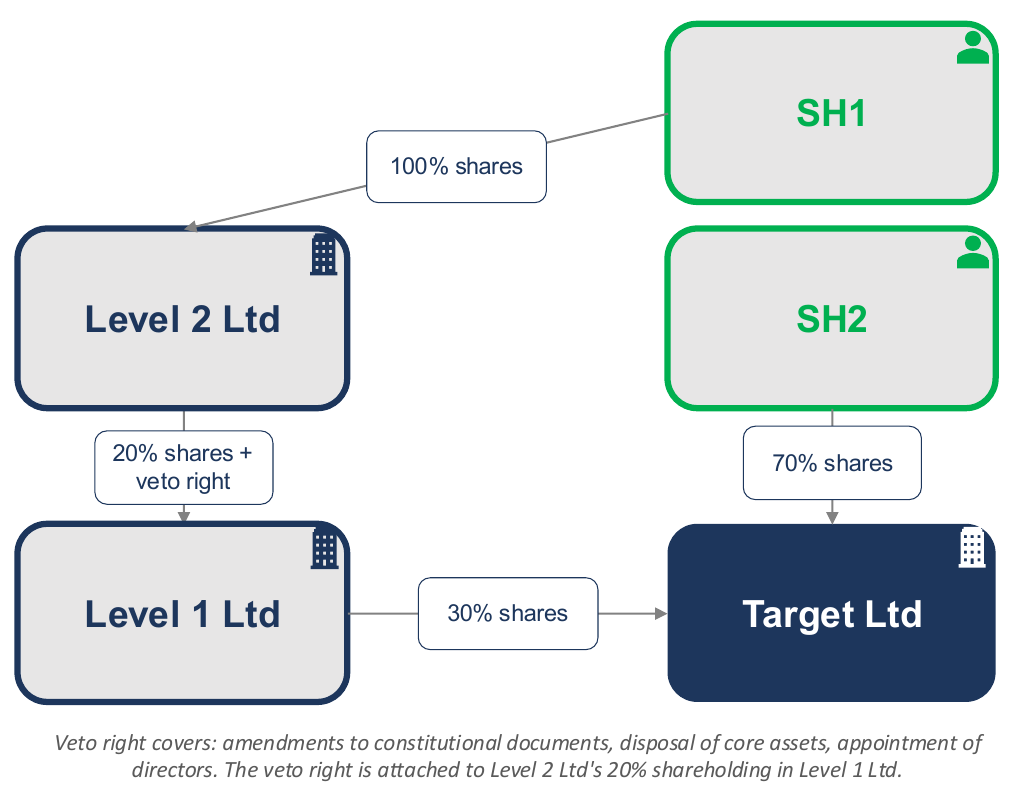
Veto right covers: amendments to constitutional documents, disposal of core assets, appointment of directors. The veto right is attached to Level 2 Ltd's 20% shareholding in Level 1 Ltd.
Assessment
- Level 2 Ltd holds 20% direct Ownership Interest in Level 1 Ltd and a veto right attached to that same shareholding covering strategic decisions → relevant veto right, Control via other means (AMLR Art. 53(3)(c)), independent of the 20% figure
- AMLR Art. 54(a): control under AMLR Art. 53(2) or (3) over an entity holding ≥ 25% in the target attributes Beneficial Ownership up the chain: Level 1 Ltd holds 30% direct Ownership Interest in Target Ltd which makes the veto right qualify as a ground for UBO as 30% ≥ 25%
Result
- Person P is a Beneficial Owner of Target Ltd through Level 2 Ltd's veto right over Level 1 Ltd, propagated one level up the chain via AMLR Art. 54(a). Person P's indirect Ownership Interest via this chain (100% × 20% × 30% = 6%) stays far below the 25% threshold and plays no role; Beneficial Owner status rests solely on the Control link
- SH2 holds Beneficial Ownership on two grounds: ownership interest and control through ownership
Case Study 13: Ownership Interest in a Controlling Intermediate
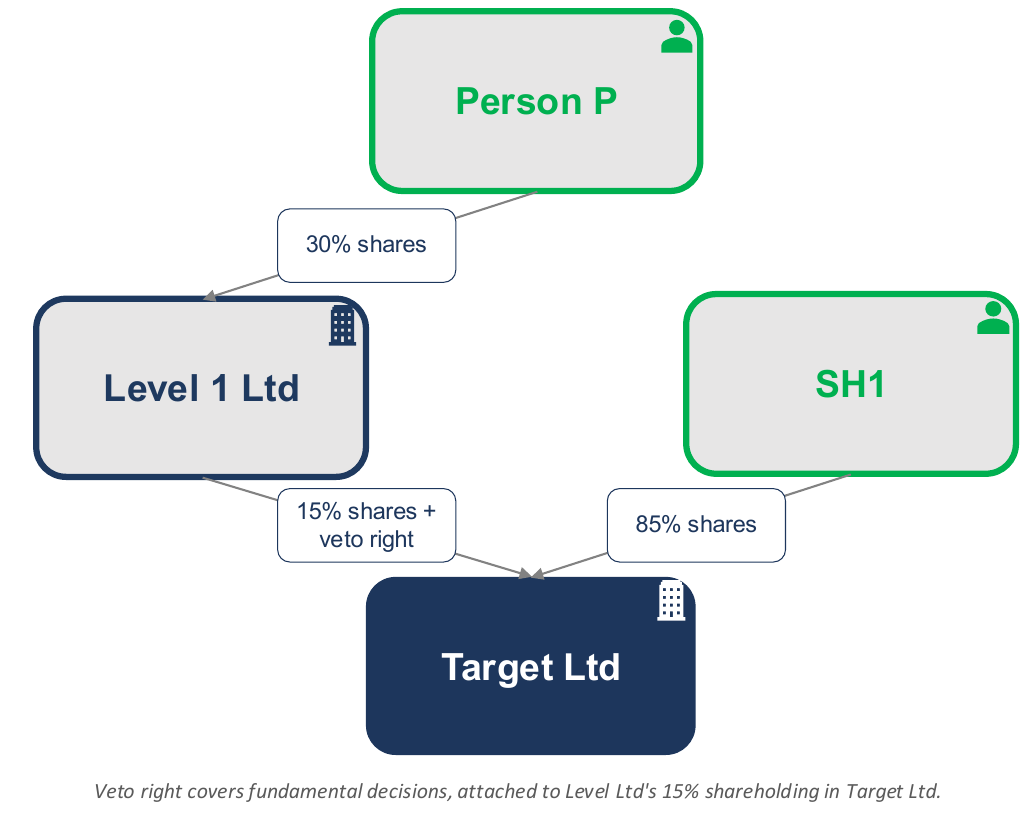
Veto right covers fundamental decisions, attached to Level 1 Ltd's 15% shareholding in Target Ltd.
Assessment
- Level 1 Ltd holds 15% direct Ownership Interest in Target Ltd, which is below the 25% threshold (AMLR Art. 52) on its own, but the veto right attached to that shareholding, covering fundamental decisions, is Control via other means (AMLR Art. 53(3)(c)).
- Person P holds 30% of Level 1 Ltd: a qualifying Ownership Interest under AMLR Art. 52 (≥25%), but not a majority, so it doesn‘t qualify for control through ownership and also multiplying 30% * 15% yields an ownership interest below the threshold.
- AMLR Art. 54(b): a person with an ownership interest in an entity that controls the target is attributed Control up the chain. Level 1 Ltd controls Target Ltd through its veto right; P's 30% is enough on its own, no majority in Level 1 Ltd is required.
- SH1: 85% direct → Ownership Interest and Control through Ownership (AMLR Art. 52, 53(2)).
Result
- Person P is a Beneficial Owner of Target Ltd via Control (AMLR Art. 54(b)), attributed through Level 1 Ltd's veto right, despite only a 30%, non-majority stake in Level 1 Ltd.
- SH1 qualifies via direct Ownership Interest and Control through Ownership.
Compare Case Study 12 (the same veto-right mechanism from the AMLR Art. 54(a) side); this case tests the AMLR Art. 54(b) side of it.
Case Study 14: Acting in Concert Below the Majority Threshold
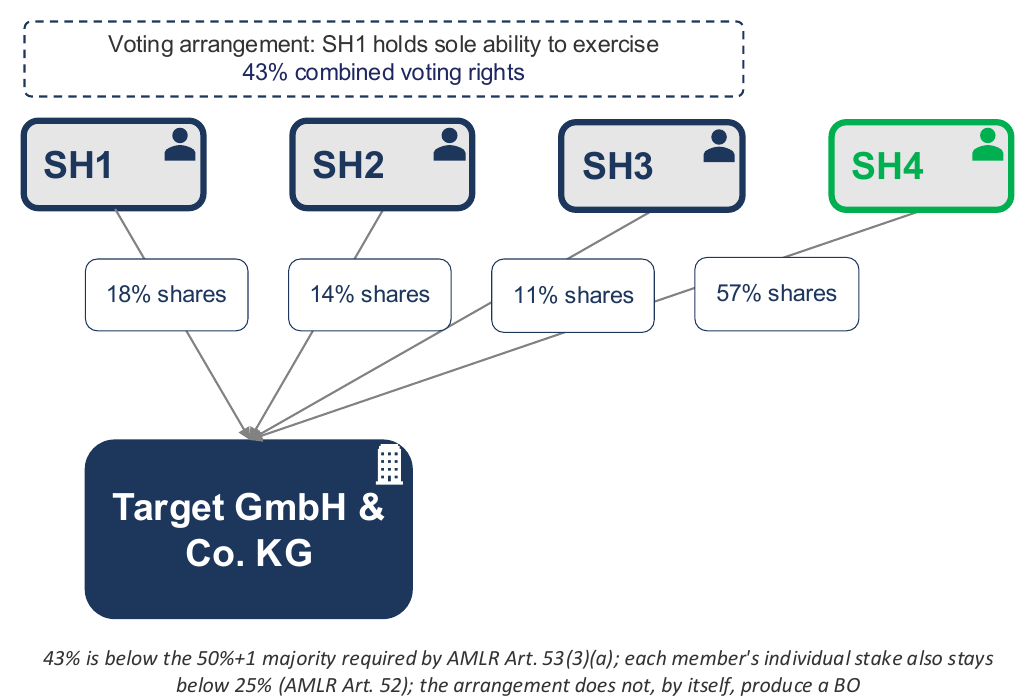
43% is below the 50%+1 majority required by AMLR Art. 53(3)(a); each member's individual stake also stays below 25% (AMLR Art. 52); the arrangement does not, by itself, produce a BO
Assessment
- SH1, SH2, SH3 individually hold 18%/14%/11%, each below 25% (AMLR Art. 52); a voting arrangement does not increase any individual's own percentage
- Combined voting rights = 43%, below the 50%+1 majority AMLR Art. 53(3)(a) requires for acting in concert to constitute Control via other means
- No other AMLR Art. 53(3)/(4) control factor is present: no veto right, no appointment right, no profit-distribution right; the arrangement covers only coordinated voting
- SH4: 57% direct, Ownership Interest (AMLR Art. 52) and control through ownership (AMLR Art. 53(2))
Result
- SH1, SH2, and SH3 are not Beneficial Owners here: neither Ownership Interest (each below 25%) nor Control (43% combined, below majority) is satisfied
- Only SH4 (57% direct) is a Beneficial Owner (Ownership Interest (AMLR Art. 52) and control through ownership (AMLR Art. 53(2)))
Transparify ties Acting in Concert strictly to AMLR Art. 53(3)(a)'s majority-of-voting-rights wording, not to coordination alone. Compare Case Study 5, where the same mechanism succeeds once the stake crosses 50%.
Case Study 15: Appointment Right Below Board Majority
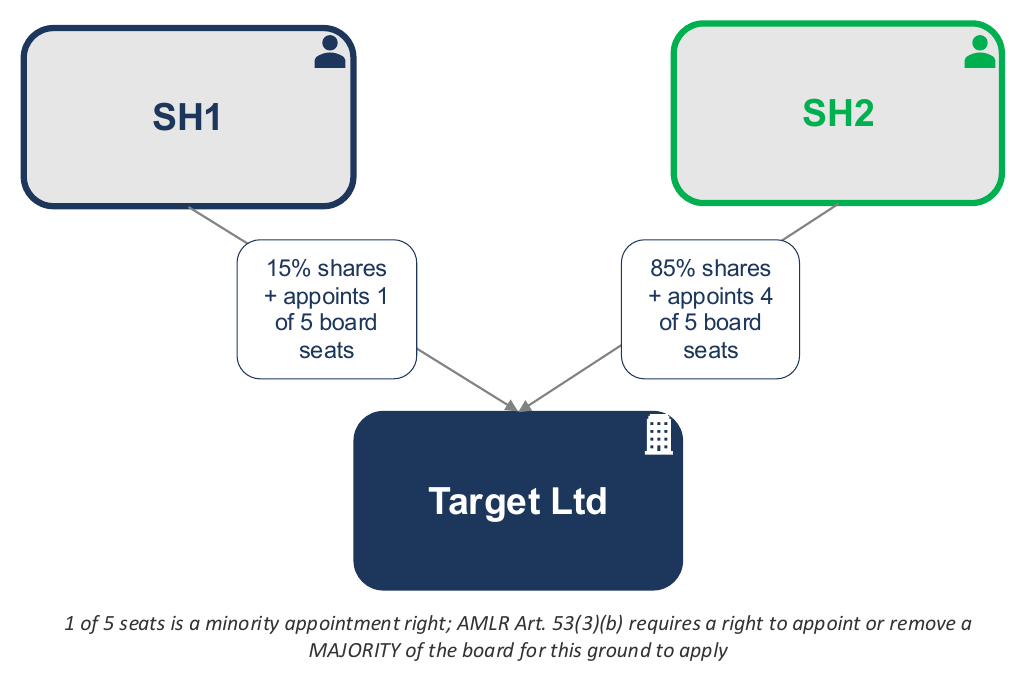
1 of 5 seats is a minority appointment right; AMLR Art. 53(3)(b) requires a right to appoint or remove a MAJORITY of the board for this ground to apply
Assessment
- SH1 holds 15% of shares, below the 25% Ownership Interest threshold (AMLR Art. 52)
- SH1's right covers 1 of 5 board seats, a minority; AMLR Art. 53(3)(b) requires a right to appoint or remove a MAJORITY of the board for this ground to apply
- No other AMLR Art. 53(3)/(4) control factor is present for SH1 (no veto right, no voting majority, no wider agreement)
- SH2: 85% direct Ownership Interest and majority Control (AMLR Art. 52, 53(2)); independently appoints the remaining 4 of 5 seats, a majority appointment right (AMLR Art. 53(3)(b))
Result
- SH1 is not a Beneficial Owner: 15% is below the Ownership Interest threshold, and a right to appoint only one of five board seats does not meet the majority requirement of AMLR Art. 53(3)(b).
- Only SH2 qualifies, via Ownership Interest, control through ownership, and independently via majority appointment rights. A minority appointment or removal right does not, on its own, create Beneficial Owner status.
Case Study 16: Veto Right Limited to Operational Matters
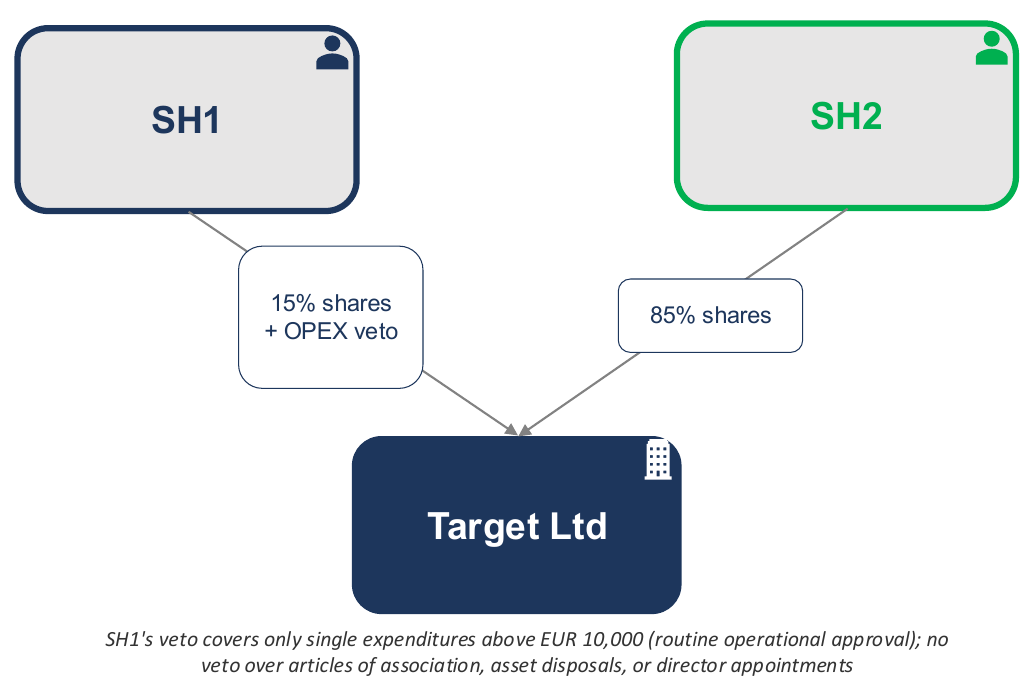
SH1's veto covers only single expenditures above EUR 10,000 (routine operational approval); no veto over articles of association, asset disposals, or director appointments
Assessment
- SH1 holds 15% of shares, below the 25% Ownership Interest threshold (AMLR Art. 52)
- SH1's veto right covers only routine operational expenditure approvals, not fundamental or strategic matters
- AMLR Art. 53(3)(c) requires a RELEVANT veto right, in Transparify’s assessment one covering decisions that determine the entity's direction; a day-to-day operational threshold does not meet this bar
- SH2: 85% direct Ownership Interest and control through ownership (AMLR Art. 52, AMLR Art. 53(2))
Result
- SH1 is not a Beneficial Owner: 15% is below the Ownership Interest threshold, and an operational expenditure veto, however practically significant day to day, is not a “relevant veto right” under AMLR Art. 53(3)(c). Only SH2 qualifies.
- Compare Case Study 6, where the veto covers fundamental matters (articles of association, core asset disposals, director appointments) and does satisfy this ground.
Case Study 17: Profit Distribution: Decision Right vs. Entitlement
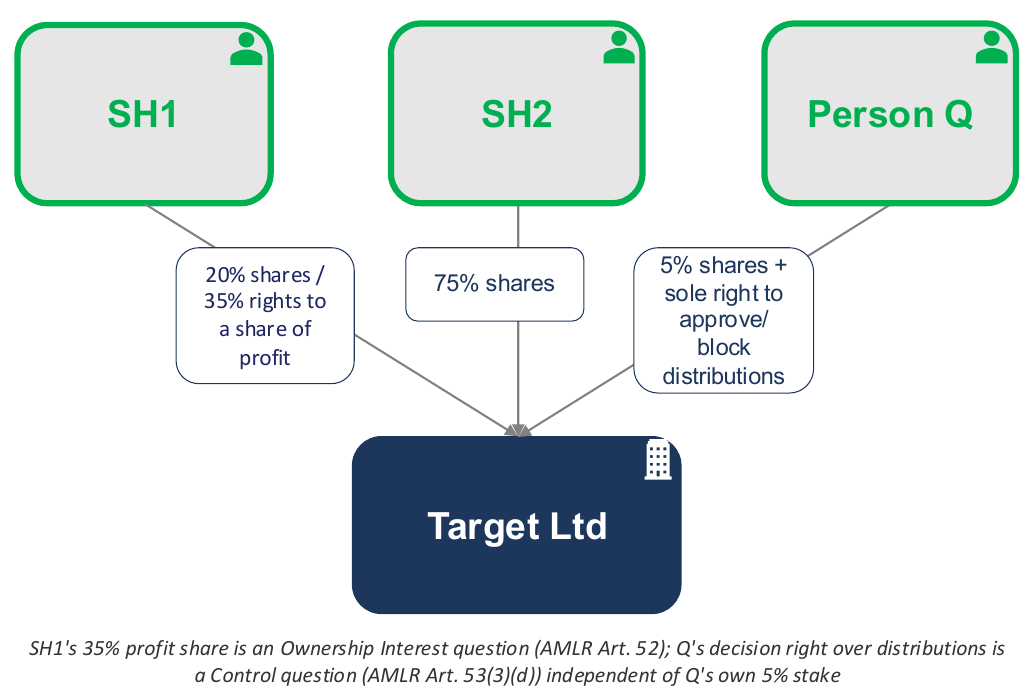
SH1's 35% profit share is an Ownership Interest question (AMLR Art. 52); Q's decision right over distributions is a Control question (AMLR Art. 53(3)(d)) independent of Q's own 5% stake
Assessment
- SH1 holds 20% of shares but a disproportionate 35% entitlement to any profit distribution: an Ownership Interest attribute under AMLR Art. 52 (“rights to a share of profits”), reaching 35% ≥ 25%
- SH1 has no say in whether or how distributions are decided: this entitlement alone does not trigger AMLR Art. 53(3)(d)
- Person Q holds only 5% of shares but has the sole contractual right to approve or block any profit-distribution resolution, independent of shareholding: Control via other means (AMLR Art. 53(3)(d))
- SH2: 75% direct Ownership Interest and control through ownership (AMLR Art. 52, AMLR Art. 53(2))
Result
- SH1, Q, and SH2 are all Beneficial Owners, but on three independent grounds:
- SH1 via Ownership Interest (35% profit share),
- Q via Control (decision right over distributions, despite only 5% of shares),
- and SH2 via ownership Interest and control through ownership
- Treating SH1's profit preference as control, or ignoring Q because of a small shareholding, would misapply AMLR Art. 51's principle that Ownership Interest and Control are assessed independently.
Continue reading: Transparify: From Regulation to Software