
Transparify White Paper · Chapter 4
SMO Fallback, Structural Edge Cases and Personal Data
The Senior Managing Official (SMO) Fallback (AMLR Art. 63(4))
If no natural person can be identified as a Beneficial Owner through either Ownership Interest or Control, AMLR Art. 63(4) requires obliged entities to identify and verify the Senior Managing Officials (SMOs) of the obliged entity. SMOs are not Beneficial Owners (Recital 125) but serve as their placeholder where beneficial ownership cannot be determined.
The SMO fallback is triggered when: no natural person holds 25% or more in any Ownership Interest category, directly or indirectly; no control factors are triggered by any identifiable natural person; or in cases where there are doubts that the identified persons are the Beneficial Owners.
AMLR Art. 63 (4) defines SMOs as the executive members of the management body as well as natural persons who exercise executive functions within the obliged entity and are responsible and accountable to the management body for day-to-day management.
When the SMO Fallback is Triggered
- No natural person holds 25% or more in any Ownership Interest category, directly or indirectly.
- No Control factors are triggered by any identifiable natural person.
- The ownership structure is too complex, opaque, or widely dispersed to identify a controlling individual.
Who are SMOs under AMLR Art. 63 (4)
- Executive members of the management body
- Operational executives: Natural persons who exercise executive functions within the legal entity and are responsible and accountable to the management body for day-to-day management
See Case Study 10 and Case Study 11.
Structural Edge Cases: Circular Shareholding & GP Structures
Two situations a straightforward ownership and control traversal cannot resolve on its own: shareholding chains that loop back on themselves, and general partners held by the limited partnership they act as general partner of
Circular Shareholding
Circular shareholding occurs when legal entity A holds an interest in legal entity B, and legal entity B holds an interest in legal entity A, directly or through a chain. Cycles must be detected during traversal: the circular path cannot be resolved to a natural person UBO, and the SMO fallback applies to the affected entities unless a non-circular path exists through other means. The same handling applies to general partners that are themselves held by the limited partnership they act as general partner of.
Limited Partnerships with a Corporate General Partner
In a limited partnership where the general partner is itself a legal entity rather than a natural person, control is exercised indirectly through those who control the general partner entity. The assessment must trace through to the natural persons who control that entity, either through majority Ownership Interest in the general partner or through its own control factors. The general partner function itself constitutes a control factor that must be assessed as part of the overall structure.
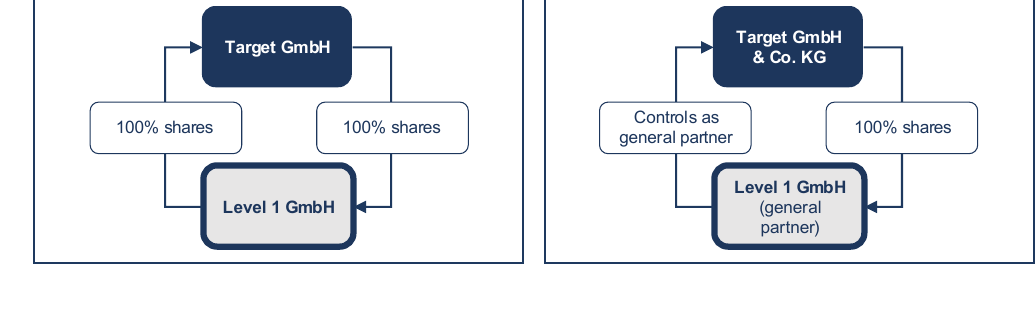
See Case Study 9 and Case Study 10.
Foundations, Trusts, Associations, and Cooperatives
Non-corporate legal persons require dedicated assessment frameworks. This is Transparify's interpretation of how the general Ownership Interest and Control provisions of AMLR Art. 51–54 apply to these structures, since the AMLR does not set out entity-type-specific rules for foundations, trusts, associations, and cooperatives in the same way it does for corporate shareholdings.
For most of these structures, the applicable capture flow is triggered automatically by the entity's selected legal form (Stiftung, e.V., eG, or GmbH & Co. KG / KG / KGaA). Trusts are the exception: a trust is not a legal form of the entity itself but a way an ownership interest can be held, so it is captured per ownership interest rather than per entity.
| Structure | Assessment Basis | How the Data is Captured |
|---|---|---|
| Foundation roles | Founders/settlors (AMLR Art. 57(1)(a)) and managing board members (b) are mandatory; supervisory/advisory body members and beneficiaries (individual or class) are captured when applicable; any other person exercising control is a residual catch-all (e). | Automatically triggered when the legal form = Stiftung. The standard ownership-interest step is skipped entirely; roles are entered directly in a dedicated Step 3 questionnaire. |
| Trust arrangements | Settlor and trustee are independently mandatory (AMLR Art. 58(1)); the protector, if any, is captured separately. Whether the trust is ordinary or discretionary determines if beneficiaries, objects of power, default takers, and selected beneficiaries apply. | Not tied to a legal form. Captured as a per-ownership-category overlay: for each ownership interest, the user answers “held through a trust arrangement?” and, if yes, works through the role and trust-type follow-ups. |
| Association board | Managing board members are captured directly as the controlling body; the general assembly's voting structure is not separately modeled. | Automatically triggered when the legal form = e.V. Ownership-interest capture is skipped entirely and replaced by the board-member step. |
| Cooperative voting | Equal voting rights per member are applied by default, computed automatically from the number of members, unless the specific statutes are entered as an override. | Automatically triggered when the legal form = eG. The voting percentage is computed, not manually entered, unless overridden. |
| General partner | In a limited partnership, the general partner exercises operational control regardless of capital contribution: control via other means, not ownership interest. | Automatically triggered for legal forms GmbH & Co. KG, KG, and KGaA. A separate general-partner control block appears alongside the normal ownership capture. |
Trust Arrangements
For most of these structures, the applicable capture flow is triggered automatically by the entity's selected legal form. Trusts are the exception: a trust is not a legal form of the entity itself but a way an ownership interest can be held, so it is captured per ownership interest rather than per entity.
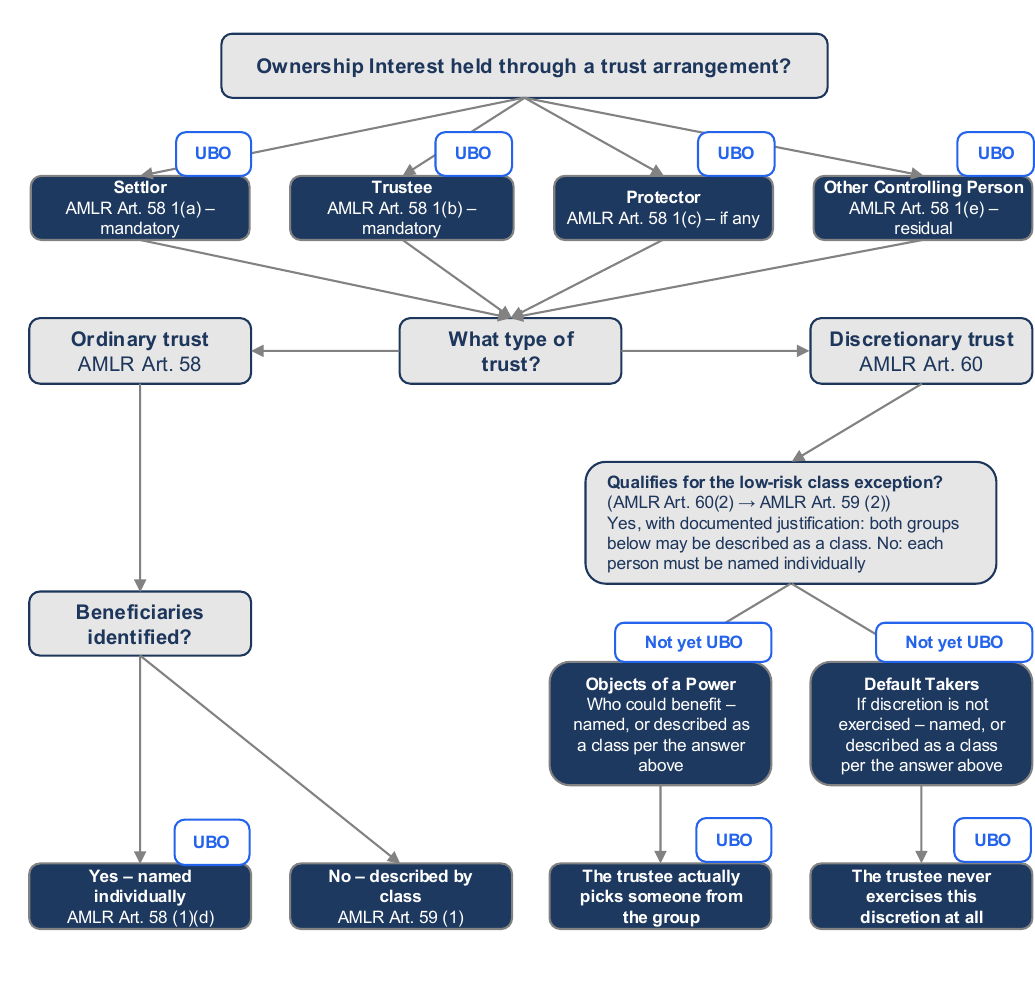
For each ownership interest held through a trust arrangement, Transparify assesses control per AMLR Art. 58(1). Because the overlay is applied per ownership category, the same holder can have a different trust structure for shares versus voting rights on the same entity.
Ownership Interest held through a trust arrangement?
- Settlor: AMLR Art. 58 1(a), mandatory (UBO)
- Trustee: AMLR Art. 58 1(b), mandatory (UBO)
- Protector: AMLR Art. 58 1(c), if any (UBO)
- Other Controlling Person: AMLR Art. 58 1(e), residual (UBO)
- Ordinary trust (AMLR Art. 58): Beneficiaries identified?
- Yes, named individually: AMLR Art. 58 (1)(d) (UBO)
- No, described by class: AMLR Art. 59 (1) (UBO)
- Discretionary trust (AMLR Art. 60): Qualifies for the low-risk class exception? (AMLR Art. 60(2) → AMLR Art. 59 (2)) Yes, with documented justification: both groups below may be described as a class. No: each person must be named individually
- Objects of a Power: Who could benefit, named, or described as a class per the answer above. Not yet UBO → The trustee actually picks someone from the group → UBO
- Default Takers: If discretion is not exercised, named, or described as a class per the answer above. Not yet UBO → The trustee never exercises this discretion at all → UBO
Foundation Roles
Under the AMLR, legal and private non-legal foundations (if they are non-charitable) are strictly subject to registration, whereas public-law foundations are entirely exempt.
For a Foundation, the legal form alone triggers this role-based assessment (AMLR Art. 57(1)(a)–(e)): the ownership-interest step is skipped entirely, and every role below is captured directly:
Always required: present in every foundation
- Founders / Settlors (UBO): Every foundation has founders by definition; zero complete entries is a gap. (AMLR Art. 57(1)(a))
- Managing Board Members (UBO): The management function always exists in a foundation. (AMLR Art. 57(1)(b))
Conditional: depends on the Yes/No answer for this foundation
- Supervisory or Advisory Body? (UBO) Yes → Supervisory/Advisory Body Members are captured as an additional controlling role. No → Not applicable; nothing further captured.
- Specific Beneficiaries Identified? (UBO) Yes → Each beneficiary is captured individually by name. No → A beneficiary class is required instead (free text, cannot be blank).
Residual catch-all: captures anyone with control not already covered above
- Other Person Exercising Control (UBO): Residual catch-all: optional, since not every foundation has an additional controlling person beyond the roles above.
Structural Edge Cases: Associations (e.V.)
The AMLR does not set out entity-type-specific rules for associations. This reflects Transparify’s interpretation of how the general Ownership Interest and Control provisions (Arts. 51–54) apply to an association (e.V.).
How Assessment Works
- No share capital, so the Ownership Interest step does not apply
- Same seven AMLR Art. 53 control factors as any other legal entity
- Includes attribution through a chain, where control runs via an intermediate structure
Board Membership by Itself
- Not treated as a control factor on its own
- A board member is a Beneficial Owner only if they separately hold one of the seven factors
- Example: a veto right reserved in the statutes, not mere board membership
SMO Fallback
- Applies automatically where no one qualifies via a control factor
- Same fallback used for any other obliged entity with no identifiable Beneficial Owner
- Executive board members are then captured as Senior Managing Officials
Structural Edge Cases: Cooperatives (eG)
The AMLR does not set out entity-type-specific rules for cooperatives. This is Transparify's interpretation of how the general Ownership Interest and Control provisions of AMLR Art. 51-54 apply to an eG.
Typically, cooperatives have diverging shares and voting rights percentages in cases where capital is distributed unequally among the cooperative members.
Assessment Basis
- Equal voting rights per member are applied by default, reflecting the one-member-one-vote principle common to cooperative statutes.
- The voting percentage per member is computed automatically from the number of members.
- An override is available where the specific statutes provide for a different allocation.
How the Tool Captures This
- Automatically triggered when the legal form is set to eG.
- The voting percentage is computed, not manually entered.
- The computed figure is only replaced if a statute-based override is entered.
See Case Study 8.
Structural Edge Cases: General Partners in a Limited Partnership
Applies to a limited partnership (KG, GmbH & Co. KG, or KGaA), where management is exercised by the general partner rather than by the partnership itself.
Assessment Basis
- The general partner exercises operational control of the limited partnership regardless of its capital contribution: this is Control via other means (AMLR Art. 53 2 (a)), not Ownership Interest.
- Where the general partner is itself a legal entity, control is exercised indirectly through whoever controls that entity: trace through via majority Ownership Interest in the general partner or its own control factors.
- If this trace-through does not identify a natural person, the SMO fallback applies to the limited partnership. Because a limited partnership has no management body of its own, the senior managing officials are those of the general partner entity, not a non-existent management of the partnership itself.
How the Tool Captures This
- Automatically triggered for the legal forms GmbH & Co. KG, KG, and KGaA.
- A separate general-partner control block appears alongside the normal ownership capture.
- Where the general partner is a legal entity, its own structure is captured and traced through in the same way as any other intermediate entity.
See Case Study 9.
Additional Personal Data
Identifying who qualifies as a Beneficial Owner is only part of the registration obligation. The ITS (Implementing Technical Standards) drafted under AMLR Art. 62(1) also require further personal data to be held and reported for each identified UBO, alongside the calculation path that established their status:
- Date of birth, nationality (or nationalities), and place of birth
- Country of residence and residential address
- Identity document type and number
- The date since which the beneficial interest is held
Most of these fields are single, straightforward attributes of the person. The date field is not: Transparify captures it separately for each nature of Ownership Interest or Control a person qualifies under, rather than one date per person. This follows the structure of AMLR Art. 62(1)(b) itself: the date sits in the same sub-point as "the nature and extent of the beneficial interest held..., whether through ownership interest or control via other means," the very clause that differentiates the individual natures of ultimate beneficial ownership. It also matches practical reality: different natures can arise or vanish at different times.
Conclusion
The sections above walk through the AMLR in full: two tracks that get assessed independently, a coexistence rule tying them together across any number of levels, seven different ways control can arise without any ownership stake at all, and a handful of structures, nominee arrangements, general partners, trusts, foundations, that don't fit the ownership-chain model to begin with.
What You Need to Know
- Ownership Interest (AMLR Art. 52): a natural person qualifies at 25% or more, held directly or indirectly, across five independently assessed categories, shares, voting rights, rights to a share of profits, rights to other internal resources, and rights to the liquidation balance.
- Indirect ownership uses the accumulation approach: percentages are multiplied along each chain and summed across parallel chains, with treasury shares excluded from the denominator at every level.
- Control (AMLR Art. 53) splits into two branches: Control through Ownership Interest requires a clear 50%-plus-one majority at each individual level of a chain, never accumulated the way AMLR Art. 52 is; Control via Other Means covers seven further grounds, appointment rights, veto rights, profit-distribution rights, acting in concert, nominee arrangements, family relationships, and formal or informal agreements.
- AMLR Art. 54 attributes Beneficial Owner status across both tracks in either direction: 54(a) where a person controls an entity that itself holds an ownership interest in the target, 54(b) where a person holds an ownership interest in an entity that itself controls the target.
- Where no natural person qualifies as UBO, the Senior Managing Official fallback (AMLR Art. 22(2), AMLR Art. 63(4)) applies.
- Foundations, trusts, associations, cooperatives, and general partners each fall outside the standard ownership-chain model and are assessed under their own dedicated framework, AMLR Art. 57 for foundations, AMLR Art. 58 to 60 for trusts, the general Control provisions for association boards and general partners, and a computed equal-voting-rights default for cooperatives.
Continue reading: Case Studies · Transparify: From Regulation to Software