
Transparify White Paper · Chapter 3
Track B: Control (AMLR Art. 53)
AMLR Art. 53 defines control as the possibility for a natural person to exercise significant influence and impose relevant decisions within an obliged entity, directly or indirectly. Control operates on two sub-tracks.
Control through Ownership Interest (AMLR Art. 53(2))
A natural person who holds, directly or indirectly, a majority Ownership Interest, defined as 50% plus one share, voting rights, or other Ownership Interest, exercises control through ownership interest. Unlike the 25% threshold under AMLR Art. 52, which uses the accumulation approach across parallel chains, control through ownership interest under AMLR Art. 53 requires a clear and consolidated majority at each individual level within a single chain of ownership.
Control via Other Means (AMLR Art. 53(3) and 53(4))
Control via other means recognises that decisive influence can be exercised independently of shareholding percentages. Art. 53(3) factors attach to formal, documented rights that can be verified directly against a defined threshold. Art. 53(4) factors arise from relationships that are often undocumented, so they require inferring the relationship itself before judging whether it amounts to decisive influence.
AMLR Art. 54: Coexistence of Ownership Interest and Control
AMLR Art. 54 addresses situations where Ownership Interest and Control coexist within the same corporate structure. This is not limited to multi-layered chains: the same coexistence logic applies to single-layer (direct) structures as well. It provides two attribution rules, covering the chain in both possible directions:
54a: Control → Ownership Interest → Target Entity
"the natural persons who control, directly or indirectly, through ownership interest or via other means, legal entities that have a direct ownership interest in the corporate entity, whether individually or cumulatively"
→ The person controls the intermediate entity; the intermediate entity holds the ownership interest in the target
54b: Ownership Interest → Control → Target Entity
"the natural persons who, whether individually or cumulatively, directly or indirectly, have an ownership interest in the corporate entity that controls, through ownership interest or via other means, the corporate entity, directly or indirectly"
→ The person holds the ownership interest in the intermediate entity; the intermediate entity controls the target.
These provisions require obliged entities to evaluate Ownership Interest and Control simultaneously and independently at every level of a multi-layered structure, not as alternative routes but as concurrent assessments.
Control Factors under AMLR Art. 53
Note: Not every control factor receives a dedicated deep-dive in this paper. The following sections focus on the factors that are most prone to misapplication in practice; the others are applied directly as described above.
Examples: Case Study 6 and Case Study 16 (veto rights), Case Study 15 (appointment rights), Case Study 17 (profit distribution).
Nominee Agreements in Detail I
A nominee agreement arises when one party, the nominee, holds an Ownership Interest or exercises a Control factor on behalf of another person or entity, the nominator, under a formal or informal agreement. Both nominee and nominator can be natural persons or legal entities. What the nominee holds on the nominator's behalf can be any of the five Ownership Interest categories, or any of the six remaining Control factors under AMLR Art. 53(3)-(4).
The nominee holds Ultimate Beneficial Ownership through whichever ground actually applies to them directly: Ownership Interest (AMLR Art. 52) once their own recorded interest reaches 25% or more, or Control (AMLR Art. 53) if they independently hold one of the other control factors.
The nominator is a different case. Whatever the nominee holds on the nominator's behalf, a share, a profit-participation right, or a control factor such as a veto right, the nominator does not hold that interest directly. The nature of the nominator's Beneficial Owner status is always Control, via the nominee arrangement itself (AMLR Art. 53(4)(c)), never Ownership Interest, regardless of what the nominee actually holds.
The extent reported alongside that nature is a percentage in all three cases: for an ownership-interest-type holding, it is the portion of the nominee's stake attributable to this nominator; for a control-factor-type holding, it is fixed at 100%, since the tool treats a control factor as a complete link; for a coexistence-type holding, the percentage is whatever is attributable to ownership interest. The figures are checked against the same 25% threshold used elsewhere in this framework, the share-based figure only passes once it actually reaches that level, the control-factor figure, fixed at 100%, always does.
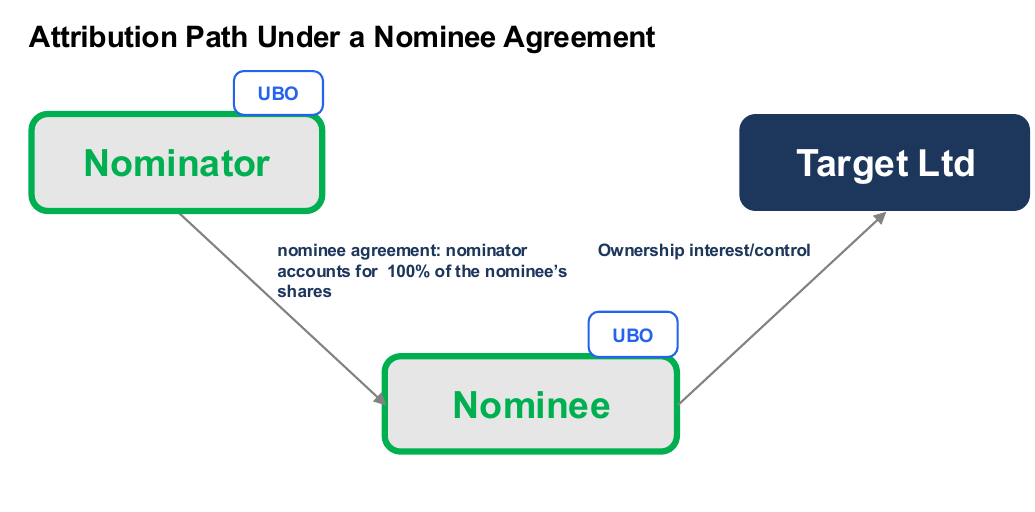
Control Pitfalls: Nominee Agreements in Detail II
Where a nominee holds or exercises the same interest or factor for more than one nominator, or only partly for one, the relevant figure for an Ownership-Interest-type holding is the nominee's stake multiplied by this nominator's share of that arrangement. A Control-factor-type holding shared by several nominators simply produces one Beneficial Owner entry per nominator, a control factor cannot be split the way a percentage can.
A trustee, a foundation board member, or an association board member can also act as a nominee for someone else, exactly as an ordinary shareholder can. Where that is the case, the role itself is reattributed to the true nominator on the same basis: the nature is Control (AMLR Art. 53(4)(c)), and the extent follows the same rules set out above.
Where the nominee or the nominator is itself a legal entity, it is resolved down to natural persons through its own ownership and control structure, exactly like any other legal entity in the chain.
See Case Study 7.
Control Pitfalls: Acting in Concert with Others
AMLR Art. 53(3)(a) ties this ground specifically to voting rights: “the majority of the voting rights in the corporate entity, whether or not shared by persons acting in concert.” A coordinated group only satisfies this ground once its combined voting rights exceed 50%, the same majority threshold that applies to control through ownership interest (AMLR Art. 53(2)). Below that threshold, acting in concert does not by itself create a Beneficial Owner.
Under AMLR, the assessment must examine:
- Whether a formal or informal arrangement to act in concert exists or can be inferred from consistent coordinated action
- Who holds the right to direct the coordinated exercise of rights on behalf of the group
- What percentage of voting rights the concerted group represents in total, and whether that combined percentage exceeds the threshold for significant influence, whatever that may be. Transparify implements a >50% threshold for combined pooled ownership interests
Continue reading: SMO Fallback and Special Structures · Case Studies