
Transparify White Paper · Chapter 2
Track A: Ownership Interest (AMLR Art. 52)
Part 2: The Calculation Logic in Depth
A deep-dive into how Ownership Interest, Control, their coexistence, the Senior Managing Official fallback, and structural edge cases are assessed under the AMLR, and how each rule translates into deterministic calculation logic.
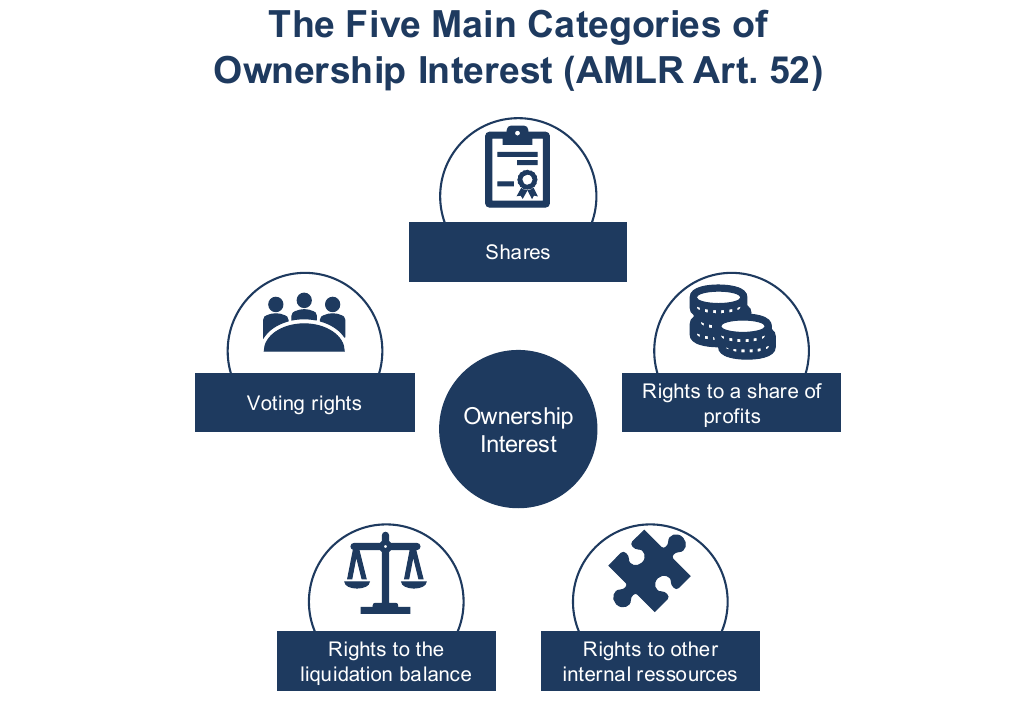
The Five Main Categories of Ownership Interest
A Beneficial Owner through Ownership Interest is any natural person who directly or indirectly holds 25% or more in an obliged entity. Under the AMLR, ownership interests include (at a minimum):
- Shares (capital interest in the obliged entity)
- Voting rights (percentage of votes exercisable at the general meeting or equivalent body)
- Rights to a share of profits
- Rights to other internal resources
- Rights to the liquidation balance
Each of these categories is assessed independently under the AMLR, and Transparify captures all five directly. They also carry a set of implications for how ownership interests are calculated and chained across multi-level structures, explored in more detail in the following sections.
Profit Share, Liquidation Balance, and Other Internal Resources
Shares and voting rights are (in most cases) concrete and well documented. The other three Ownership Interest categories point to real, recognized legal constructs, even where no capital or voting position exists at all:
- Usufruct over a share (e.g. §§ 1030, 1068 BGB in Germany): the usufructuary receives the profit distribution without holding the share itself or any voting rights.
- Profit participation certificates and silent partnerships: purely contractual profit-sharing, sometimes extending to liquidation proceeds, without membership or voting rights.
- Sub-participation: a further-removed stake in someone else’s participation.
- Virtual share or phantom stock plans (VSOP): common in startups: contractual profit- or exit-participation without any corporate membership.
- Liquidation preferences in shareholder agreements: contractual priority or a multiple on exit proceeds, independent of the underlying capital share.
Own Shares Adjustment
When an obliged entity holds its own shares (treasury shares), those interests do not represent external ownership and must be excluded from the denominator before calculating each external shareholder’s effective percentage.
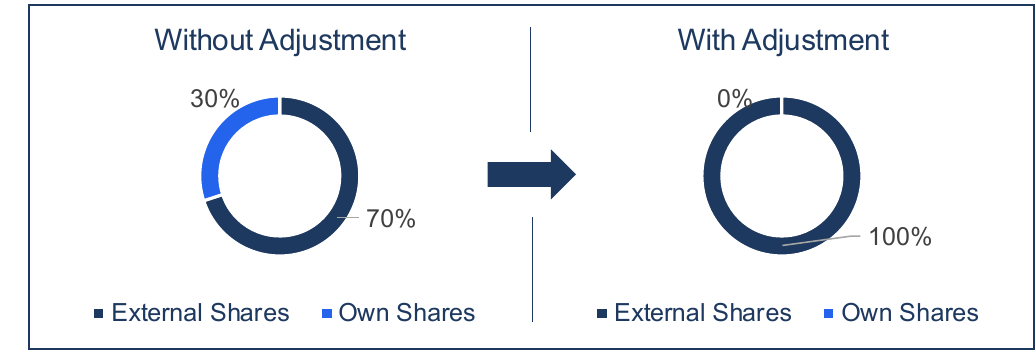
See Case Study 3 and Case Study 4.
Multi-Level Chains: The Accumulation Approach (AMLR Art. 52(1))
For multi-layered corporate structures, the AMLR determines indirect ownership through the accumulation approach: ownership percentages are multiplied along each hierarchical layer to determine ultimate ownership. A chain is the single path of intermediate entities connecting the entity being assessed to the natural person ultimately holding the ownership interest. Where a natural person holds interests through multiple separate chains, each chain is calculated independently, resolved until the last layer, and the results are added together.
Key rules for multi-level chains:
- Transparify’s tool logic chains each Ownership Interest category (shares, voting rights, rights to a share of profits, rights to other internal resources & rights to liquidation balance) through its own category across every level: a chain that starts in shares stays in shares, with a narrow structural stand-in (that entity’s shares or voting rights, whichever is available) only where an intermediate entity has no recorded value for the category being traced. This is one implementation choice among two possible readings of AMLR Art. 52(1); see Same-Category Chaining.
- Where multiple paths exist from the same natural person to the same target, the computed percentages from each path and category of ownership are summed up.
- Treasury share adjustments at each intermediate entity level are applied before the multiplication step.
- Cycle detection is required: if the path contains a circular reference, special handling applies (Circular Shareholding).
At each entity level, treasury shares and circular / cycle holdings (cross-ownership back into the path) are excluded from the calculation basis and the remaining external percentages are scaled onto that reduced basis before any chain multiplication.
Under this implementation, effective indirect ownership equals the product of percentage stakes along each holding chain, tracked separately per Ownership Interest category. Stakes reaching the same natural person through different chains in the same category are summed.
Accumulation Approach
- Follow each chain by category through all layers
- Multiply percentages along each chain
- Sum results from multiple chains to the same target
Example:
Natural Person → 80% voting rights → Intermediate Entity → 60% voting rights → Target Entity
80% × 60% = 48% ≥ 25% → UBO status triggered
See Case Study 2.
Why Shares and Voting Rights Serve as the Structural Stand-In
The structural stand-in exists for the case where a specific intermediate holder's profit-share, other-resource, or liquidation-balance interest was never entered. Rather than stopping the chain at that point, the engine falls back to that holder's shares or voting rights, which are normally on file, so the calculation can continue.
This substitution runs in one direction only: shares or voting rights may substitute for a missing value in the other three Ownership Interest categories (rights to a share of profits, other internal resources, liquidation balance) at an intermediate holder. It never runs the other way. This is not an arbitrary implementation choice; it mirrors an asymmetry that already exists in company law itself.
Why This Direction Works
- Absent a differing arrangement, most company-law regimes presume that profit share, internal-resource entitlements, and liquidation proceeds track the capital stake (e.g. § 29 GmbHG's default rule for profit distribution)
- Shares and voting rights are also, in practice, the most reliably and consistently recorded data points in real ownership structures (shareholder registers, commercial registers); the other three categories are typically documented at all only when they are deliberately made to diverge
- The stand-in simply follows a default that company law already provides.
Why the Reverse Does Not Hold
- There is no comparable default rule that infers a capital or voting stake from a documented profit or liquidation entitlement
- An arrangement limited to a share of profits or liquidation proceeds, with no capital or voting stake at all, is a common and deliberate structure (silent partnerships, profit-participation rights, Genussrechte) chosen specifically to avoid creating a capital or voting position
- Assuming the reverse would fabricate a capital or voting stake that the parties may have deliberately chosen not to create
Same-Category Chaining: Why AMLR Art. 52(1) Requires Consistency
AMLR Art. 52(1) states that indirect ownership 'is calculated by multiplying the shares or voting rights or other ownership interests held by the intermediate entities in the chain of entities ... and by adding together the results from those various chains.' This wording has been read two ways. Transparify implements same-category chaining: each Ownership Interest category is calculated as its own internally consistent percentage across the entire chain. Mixed-category chaining does not survive scrutiny of what AMLR Art. 52(1) actually asks for.
Why Same-Category Chaining Is Correct
- A person's percentage of voting rights in the target entity is only meaningful if voting-rights percentages are multiplied with voting-rights percentages at every level in the chain
- AMLR Art. 52(1) asks a specific question, namely what percentage of shares, or what percentage of voting rights, or what percentage of another ownership interest a person holds. Mixing categories partway through the chain produces a hybrid figure that answers none of these three questions
- The multiplication logic itself only holds within a single category. Multiplying a 40% shareholding at one level by a 30% voting-rights position at the next level does not yield a defined percentage of anything
Why Mixed-Category Chaining Does Not Hold
- The "or" in AMLR Art. 52(1) lists shares, voting rights, and other interests as alternative bases, not interchangeable units to multiply together
- A mixed result cannot be tested against the 25% threshold, since a person cannot hold "25% of shares-multiplied-by-voting-rights“
- Each right is a legally distinct instrument. Treating them as fungible assumes a convertibility company law does not provide
Continue reading: Track B: Control (AMLR Art. 53) · Case Studies