
Transparify White Paper · Chapter 1
The Regulatory Framework
This part lays out the regulatory context practitioners need before working through the calculation logic in Part 2. It explains what actually changes as national directive transpositions give way to the directly applicable AMLR, who is required to comply and in what role, and introduces the Art. 51 to 54 framework, built around two independent tracks, Ownership Interest and Control, that the rest of this paper applies in detail.
From Fragmentation to Harmonisation
The AMLR replaces fragmented national implementations of EU directives 1-6 with a directly applicable EU regulation from 10 July 2027. It introduces a broader and more structured assessment methodology that must be applied consistently and documented transparently.
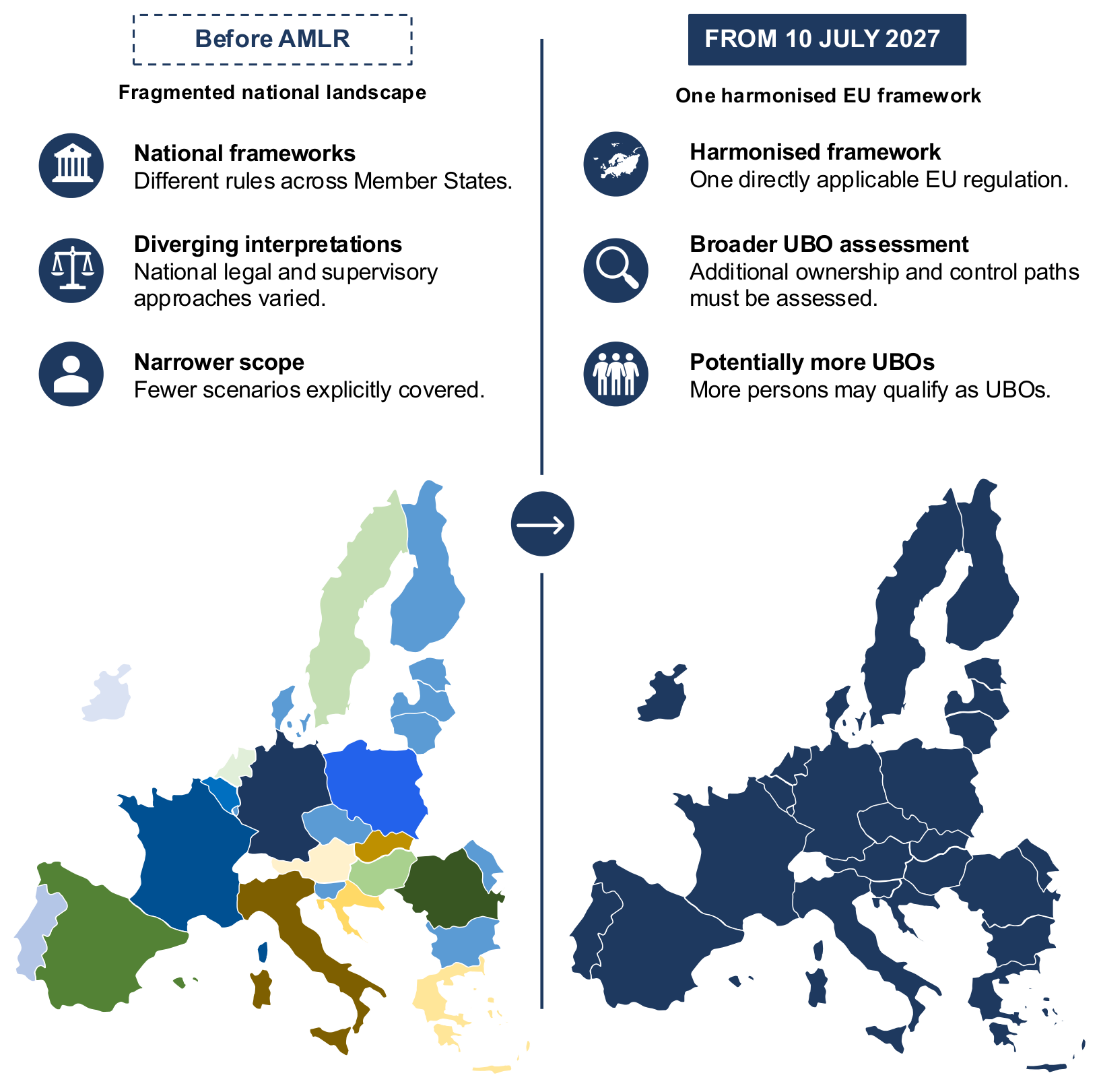
Before AMLR: Fragmented national landscape
- National frameworks: Different rules across Member States.
- Diverging interpretations: National legal and supervisory approaches varied.
- Narrower scope: Fewer scenarios explicitly covered.
From 10 July 2027: One harmonised EU framework
- Harmonised framework: One directly applicable EU regulation.
- Broader UBO assessment: Additional ownership and control paths must be assessed.
- Potentially more UBOs: More persons may qualify as UBOs.
What the AMLR Changes for UBO Assessment
The EU Anti-Money Laundering Regulation (AMLR, EU 2024/1624) fundamentally changes how obliged entities identify, assess and document Beneficial Owners. This white paper explains the regulatory framework and demonstrates how Transparify translates these requirements into a structured, deterministic and auditable assessment methodology.
Executive Summary
- AMLR replaces national AML directive transpositions with a single directly applicable EU regulation, effective 10 July 2027.
- Beneficial ownership is assessed through two independent legal tracks: Ownership Interest (AMLR Art. 52) and Control (AMLR Art. 53). Where both apply, AMLR Art. 54 ensures their parallel coexistence, regardless of the complexity of the ownership structure.
- Ownership Interest includes shares, voting rights and additional economic interests defined by the AMLR. Indirect holdings are calculated using an accumulation approach by multiplying ownership interest percentages along each ownership chain and summing parallel chains.
- Control may establish Beneficial Owner status independently of any ownership percentage. Article 53 defines (so far) seven control factors, complemented by three special legal structures that create BO status on separate legal grounds.
- Where no natural person qualifies as a Beneficial Owner, the Senior Managing Official (AMLR Art. 63(4)) serves as the mandatory fallback. The second-tier criteria (executive function, day-to-day responsibility and management accountability) apply cumulatively to the same individual.
Who is Obliged?
The AMLR distinguishes between entities that identify and register their own Beneficial Owners and obliged entities that verify those registrations during their Customer Due Diligence.
AMLR Art. 63 (1): „All legal entities created in the [European] Union shall obtain and hold adequate, accurate and up-to-date beneficial ownership information.“
Registration Obligation
AMLR Art. 62-63 require legal entities and other legal persons (including trusts and similar legal arrangements) to identify their own Beneficial Owners, hold adequate, accurate, and current information on them, and submit and maintain that information with the relevant national UBO Register. AMLR Art. 67 extends a registration obligation to foreign (non-EU countries) legal entities and legal arrangements that meet certain connecting criteria to the EU.
Customer Due Diligence
Obliged entities performing Customer Due Diligence, in particular banks, face a related but distinct task: independently determining the UBO from primary sources, then cross-checking that result against the determination provided by the client or its advisor, rather than merely accepting the client-side assessment at face value. The calculation logic in Parts II and III of this paper applies equally to this independent determination step.
Target Audience
Separately, AMLR also defines a set of obliged entities (banks, law firms, notaries, tax advisors, real estate agents, crypto-asset service providers, and similar) that must perform Customer Due Diligence, which includes identifying and verifying the UBOs of their customers, consulting the UBO Register as part of a multi-prong verification approach under AMLR Art. 22(7). These obliged entities are not themselves the companies that must register UBOs; they are the ones checking the register entries of their customers during their verification process.
Who This Paper Is For
This paper is written for law firms, tax advisors, notaries, and financial institutions performing UBO assessments for their clients. Law firms, tax advisors, and notaries typically access shareholder agreements, voting arrangements, acting-in-concert arrangements, and nominee agreements directly; banks and financial institutions instead determine the UBO independently and reconcile it against the customer's UBO submission in the central registry. Register data alone, reflecting only nominal shareholding, is not sufficient.
The Preparing Party and the Verifying Party
| The Preparing Party | The Verifying Party |
|---|---|
| Companies, trusts, and similar legal arrangements, including foreign entities meeting EU connecting criteria (AMLR Art. 67) | Banks · Law firms & notaries · Tax advisors · Real estate agents · Crypto-asset service providers |
| Must self-identify their own Beneficial Owners (AMLR Art. 62-63) | Must perform Customer Due Diligence: identify and verify their customers’ UBOs (AMLR Art. 22(7)) |
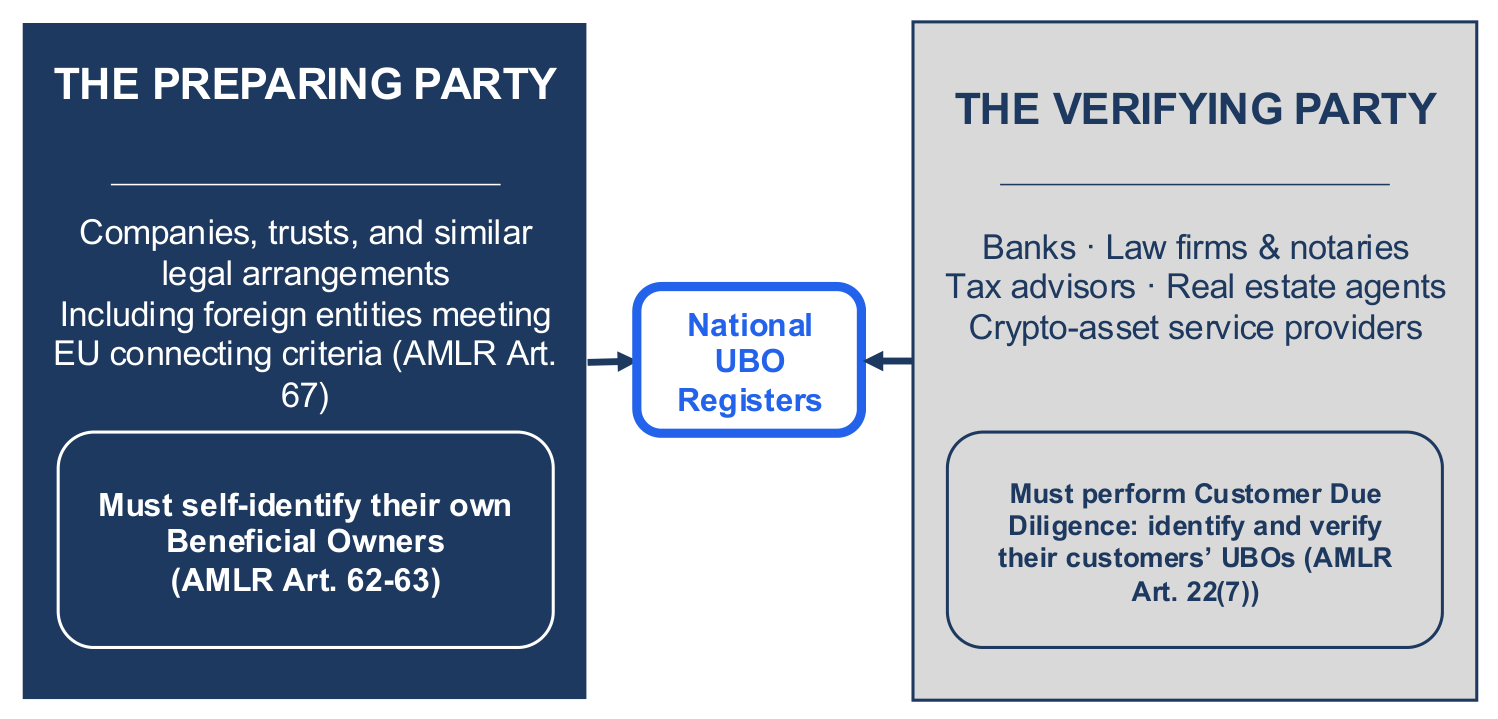
Two distinct instances, each determining independently: one prepares and files with the register, the other verifies its own result against the client's.
The AMLR Articles 51–54 Framework
AMLR Articles 51–54 establish the framework for identifying Beneficial Owners of obliged entities:
- AMLR Art. 51 establishes the overarching principle: Ownership Interest and Control must be assessed independently and in parallel. The presence or absence of one does not affect the assessment of the other.
- AMLR Art. 52 defines Beneficial Ownership through Ownership Interest: a natural person who directly or indirectly holds 25% or more of an obliged entity’s shares, voting rights, or other Ownership Interests is a Beneficial Owner.
- AMLR Art. 53 defines Beneficial Ownership through Control: a natural person who controls an obliged entity through majority ownership interest (50% + 1 share or voting rights), or through control via other means, is a Beneficial Owner.
- AMLR Art. 54 addresses the coexistence of Ownership Interest and Control, providing two specific attribution rules for identifying UBOs where ownership and control intersect. This applies equally to single-layer and multi-layered corporate structures, not just to multi-layered chains.
| Instrument | Key Provisions |
|---|---|
| AMLR (EU) 2024/1624 | Directly applicable regulation governing obliged entity duties, including UBO identification and Customer Due Diligence (CDD). AMLR Art. 51-54 define Beneficial Ownership. AMLR Art. 62-65 require legal entities to self-identify and register their UBOs in their home Member State's national register, established under AMLD6. Applies from 10 July 2027. |
| AMLD6 (EU) 2024/1640 | Accompanying directive governing the national setup of central registers, supervisory frameworks, and the reporting process. |
| RTS on AMLR Art. 28 (draft Feb. 2026) | Regulatory Technical Standards drafted by the AMLA. Once formally adopted by the European Commission, they will set binding requirements for UBO identification and verification procedures. |
| ITS under AMLR Art. 45(6) AMLD6 | Implementing act specifying the format for submitting UBO data to national central registers, including a minimum-requirements checklist. |
Continue reading: Part 2: Ownership Interest (AMLR Art. 52) · Control (AMLR Art. 53) and Coexistence (Art. 54)